4-minute story
The end of the Yadu clan
4 min read · as told in the Bhagavata Purana (Book 11, chapters 1, 30 and 31)
The last burden
The Bhagavata Purana tells that when Krishna’s work on earth was almost done, one burden remained. His own clan, the Yadavas, had grown so strong that no one could ever defeat them.
Krishna decided that the clan must come to an end, and that a curse spoken by sages would be the cause.
A foolish joke
Some great sages, Narada among them, had been staying in Dvaraka, and had moved on to a holy place called Pindaraka.
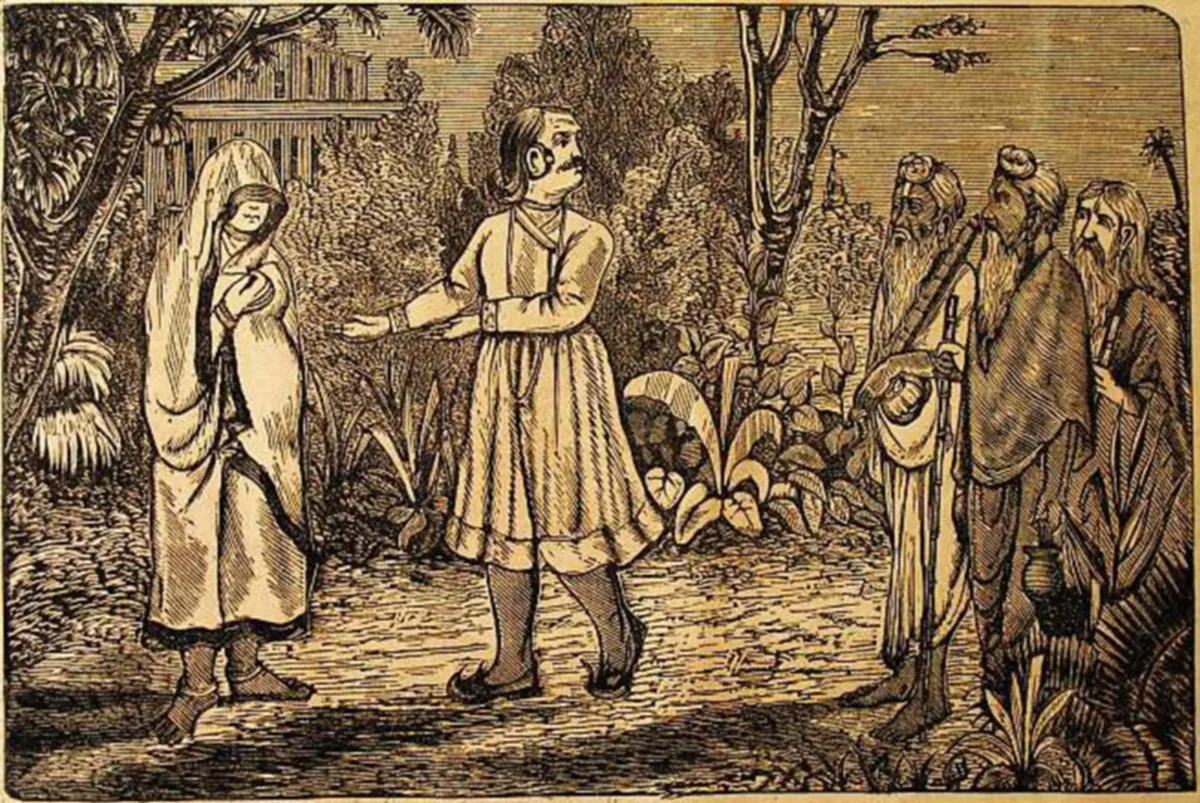
A group of Yadava boys decided to have some fun with them. They took Samba, one of Krishna’s sons, and dressed him up in women’s clothes. Then they led him before the sages.
This lady is expecting a child, they said, trying not to laugh. She is too shy to ask. Will it be a boy or a girl?
The sages saw through the trick at once. Fools, they said. She will give birth to an iron club, and it will destroy your whole clan.
The club
The boys stopped laughing. They pulled away Samba’s robe, and there, underneath, was an iron club.
Terrified, they carried it to King Ugrasena. He ordered the club to be ground into powder, and the powder, and the last little lump of iron, to be thrown into the sea.
But a fish swallowed the lump. A fisherman caught the fish, and a hunter named Jara found the piece of iron inside, and made it into the tip of an arrow. And the iron powder washed up on the shore.
Krishna knew all this. He could have undone the curse. He chose not to.
Prabhasa
Some time later, Krishna saw frightening signs, and told the Yadavas to leave Dvaraka. The women, children and old people went to one place of safety. The men went with Krishna to Prabhasa, a holy place by the sea, to bathe and to pray.
But there, their minds grew clouded. They drank a strong sweet drink, and began to argue, and then to fight. They fought with arrows, and when the arrows ran out they tore up the canes growing on the shore, and the canes turned into iron rods in their hands.
Pradyumna fought his brother Samba. Fathers fought sons; brothers fought brothers; friends fought friends. Like a fire that starts in one bamboo grove and burns the whole forest, the fighting spread until the clan was gone.
Balarama, Krishna’s elder brother, sat down on the shore, closed his eyes, and left this world.
The hunter
Krishna sat quietly under a tree, his left foot resting on his right thigh, its sole reddish, like a lotus.
Not far away, the hunter Jara was creeping through the trees. He saw something reddish moving among the leaves, and thought it was a deer. He fitted the arrow with the iron tip, and let it fly.
Then he ran up, and saw what he had done.
He threw himself at Krishna’s feet. Forgive me, he wept. Punish me. I did not know.
Krishna looked at him kindly. Do not be afraid, he said. This happened because I wished it.
Jara bowed to him again and again, and the Purana says he was carried to the spiritual world.
Going home
Krishna’s charioteer Daruka came searching for him, and found him under the tree, and wept. Krishna told him: go back to Dvaraka. Tell everyone what has happened, and tell them to leave the city with Arjuna. Soon the sea will cover it.
Then Brahma and Shiva and all the gods gathered in the sky, and flowers fell like rain. Krishna closed his eyes, and returned to his own abode. The Purana says that he came and went the way an actor comes on and leaves the stage: by his own will, in his own play.
The sea
When the news came to Dvaraka, Krishna’s parents, Vasudeva and Devaki, died of grief. Arjuna came, and saw that every rite was done for the dead, and led the survivors away to Indraprastha, where he made Krishna’s great-grandson Vajra their king.
Behind them, the sea rose and covered Dvaraka. Only Krishna’s own palace was left above the waves.
The Bhagavata Purana also tells that many of the Yadava wives followed their husbands into the funeral fires. The practice it describes, sati, is condemned today and is against the law in India.
Also named in this story
- Krishna
- Worshipped as God, and as an avatar of Vishnu; in this story king in Dvaraka.
- Balarama
- Krishna's elder brother.
- Samba
- A son of Krishna and Jambavati.
- Ugrasena
- King of the Yadavas.
- Jara
- A hunter, who shot the iron-tipped arrow.
- Daruka
- Krishna's charioteer.
- Arjuna
- Krishna's friend, the great archer of the Mahabharata.
- Vajra
- Krishna's great-grandson, who ruled the surviving Yadus.
- Pradyumna
- A son of Krishna and Rukmini.
- Brahma
- The creator god.
- Shiva
- One of the three great gods.
- Devaki
- Krishna's mother.
- Vasudeva
- Krishna's father.
- Narada
- The travelling sage.
Sources
- Bhagavata Purana, Canto 11, chapter 1 11.1.3–24 · Verified
- Bhagavata Purana, Canto 11, chapter 30 11.30.4–50 · Verified
- Bhagavata Purana, Canto 11, chapter 31 11.31.1–25 · Verified
- Bhagavata Purana, Canto 11, chapter 1 11.1.3–24 · Verified
- Bhagavata Purana, Canto 11, chapter 30 11.30.4–50 · Verified
- Bhagavata Purana, Canto 11, chapter 31 11.31.1–25 · Verified