3-minute story
Pradyumna and the fish
3 min read · as told in the Bhagavata Purana (Book 10, chapter 55)
The god of love
Kama, the god of love, had once been burned to ashes by the fire of Shiva’s anger. But love cannot stay gone for ever. Kama waited, and in time he was born again, as Pradyumna, the son of Krishna and his queen Rukmini.
Stolen
The asura Shambara heard of the baby’s birth, and he was afraid. This child, he thought, will be my enemy.
Before the baby was even ten days old, Shambara crept in, snatched him up, and carried him away. He threw him into the sea, and went home pleased with himself.
The fish
But the baby did not drown. A great fish swallowed him whole.
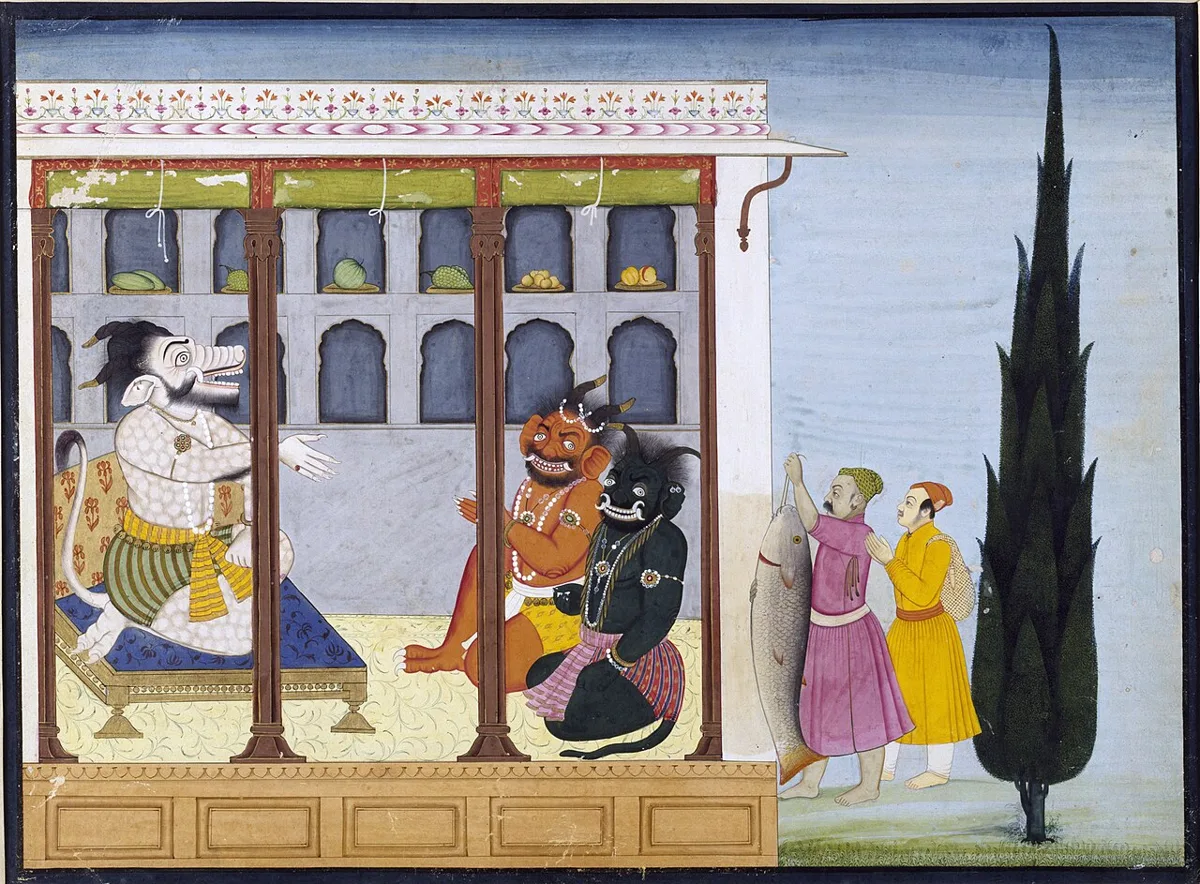
Some time later, fishermen cast their nets, and caught that very fish. It was so big and fine that they carried it as a gift to the king, Shambara himself.
In Shambara’s kitchen, the cooks began to cut the fish open. And inside they found a baby boy, alive.
Mayavati
The cooks gave the baby to a woman of the household named Mayavati. She looked at the child, amazed, and then she understood. This was Kama.
For Mayavati was not who she seemed. She was Rati, Kama’s wife. When Kama was burned, she had come to live in Shambara’s house, to wait for her husband to be born again. Now he had come to her, out of the belly of a fish.
She raised him lovingly. He grew into a young man so handsome that everyone who saw him was enchanted.
The truth
When he was grown, Rati told him everything. You are the son of Krishna and Rukmini, she said. I am Rati, your wife from your life as Kama. Shambara stole you as a baby and threw you into the sea. Your mother still weeps for you.
The Bhagavata Purana tells this conversation in more detail. This story tells what happens without that detail, as the rest of the site does.
Then she taught him the Maha-maya, a great power of illusion that no other magic can stand against.
The challenge
Pradyumna went straight to Shambara and challenged him to fight. Shambara rushed out, roaring, and hurled his club. Pradyumna knocked it aside.
Shambara tried every weapon he had, and every trick of magic. But each one melted away before the Maha-maya. At last Pradyumna raised his sword, and Shambara fell.
A stranger in the palace
Rati carried Pradyumna up into the sky, and they flew all the way to Dvaraka, and came down inside Krishna’s palace.
The women of the palace looked up and saw a dark, handsome young man. It’s Krishna, they whispered, and hid their faces. Then they looked again. No. He was very like Krishna, but it was someone else.
Rukmini looked at him for a long time. My son would be this age now, she thought. Who is this, who looks so like my husband? Something in her heart was certain, but she did not dare believe it.
Then Krishna came in, with his parents Devaki and Vasudeva. Krishna knew everything, but he said nothing. It was the sage Narada who told them the whole story: the theft, the sea, the fish, and Rati’s long wait.
All Dvaraka rejoiced. It was as if a son had come back from the dead.
Also named in this story
- Pradyumna
- Son of Krishna and Rukmini, Kama born again.
- Krishna
- Worshipped as God, and as an avatar of Vishnu; in this story king in Dvaraka.
- Rukmini
- Krishna's chief queen, Pradyumna's mother.
- Kama
- The god of love.
- Rati
- Kama's wife.
- Mayavati
- The name Rati used in Shambara's household.
- Shambara
- An asura king.
- Shiva
- One of the three great gods.
- Narada
- The travelling sage.
- Devaki
- Krishna's mother.
- Vasudeva
- Krishna's father.
Sources
- Bhagavata Purana, Canto 10, chapter 55 10.55.1–16 · Verified
- Bhagavata Purana, Canto 10, chapter 55 10.55.17–40 · Verified
- Bhagavata Purana, Canto 10, chapter 55 10.55.1–16 · Verified
- Bhagavata Purana, Canto 10, chapter 55 10.55.17–40 · Verified