4-minute story
Parashurama, the warrior sage
4 min read · as told in the Bhagavata Purana (Book 9, chapters 15 and 16), with the Valmiki Ramayana
A warrior in a family of sages
The sage Richika, of the ancient line of Bhrigu, married Satyavati, daughter of King Gadhi. Their son was the sage Jamadagni, and Jamadagni married Renuka. Their youngest son was named Rama. Because he carried an axe, a parashu, he is remembered as Parashurama.
The Bhagavata Purana honours him as an avatar of Vishnu. In his time, it says, the warrior kings of the earth had grown proud and unjust, and Vishnu was born into a family of brahmanas to bring them down.
The king with a thousand arms
Kartavirya Arjuna was king of the Haihayas. He had worshipped the great sage Dattatreya and received extraordinary gifts: a thousand arms, great strength and fame. Once, it is said, he even held back the river Narmada with his arms and captured Ravana himself, then let him go.
One day, out hunting with his army, Kartavirya came to Jamadagni’s hermitage. The sage received the king and all his men as guests, and fed them all, for he owned a wish-fulfilling cow that gave whatever was needed.
The king and his men looked at the cow and wanted it. At Kartavirya’s word, his men took the cow and her calf by force and led them away, crying, to the king’s city.
The axe
Parashurama came home and heard what had happened. He picked up his axe, his bow, his quiver and his shield, and went after the king like a lion after an elephant.
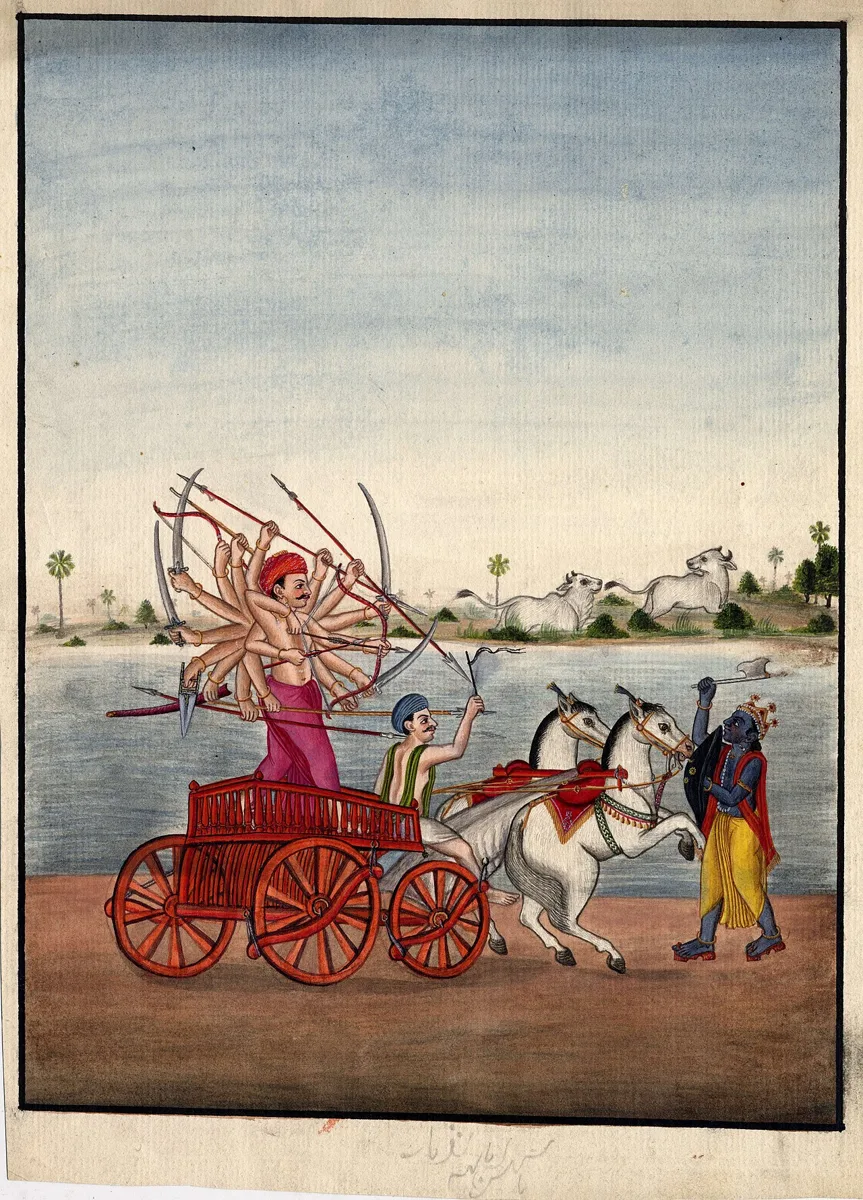
Kartavirya sent his army against him, a vast host of chariots, elephants, horses and soldiers. Parashurama cut through it alone. Then the king himself came at him, with five hundred bows in his thousand hands. Parashurama cut off the arms one by one with his axe, and then he killed the king. He brought the cow and her calf home to his father.
A father’s rebuke
Jamadagni did not praise him. My son, he said, you have done wrong. A king carries the authority of the gods, and you have killed one. We brahmanas are honoured in the world because we forgive. Go, visit the holy places, and wash away this sin.
Parashurama obeyed. For a whole year he travelled from one holy place to the next, and then he came home.
A hard command
The Bhagavata Purana tells a hard story next. One day Renuka went to the Ganges for water, and was so distracted by the sight of a heavenly king playing in the river that she came home late, after the time for her husband’s fire sacrifice had passed. Jamadagni, in his anger, ordered his sons to kill her. One by one they refused. Only Parashurama, who knew his father’s power, obeyed him.
His father, pleased, offered him any boon. Parashurama asked only that his mother and brothers live again, and that they remember nothing of what had happened. And so it was.
The sons of Kartavirya
Kartavirya’s sons had not forgotten their father’s death. One day, when Parashurama and his brothers were away in the forest, they came to the hermitage and found Jamadagni sitting in meditation. Renuka begged them for her husband’s life, but they killed him.
Renuka’s cry rang out through the forest: Rama! My son Rama! Parashurama and his brothers came running, and found their father dead.
Twenty-one times
Grief and rage took hold of Parashurama. He swore to rid the earth of the proud warrior kings. He went first to the city of Kartavirya’s sons, and then against all the warrior kings, and the Bhagavata Purana says he did this twenty-one times over.
The axe laid down
When it was over, Parashurama restored his father, who rose to become one of the seven great sages. He held a great sacrifice and gave away the whole earth to the priests. Then he bathed in the river Sarasvati, set aside his weapons, and went to live on Mount Mahendra as an ascetic, at peace.
The Valmiki Ramayana tells of one last challenge. When the young Rama broke Shiva’s bow, Parashurama came down from his mountain to test him, with a bow that had once belonged to Vishnu. Rama strung it with ease, and Parashurama knew that he was looking at Vishnu himself. He bowed to Rama, and went back to Mahendra. Explore next: Shiva’s bow and the wedding of Rama and Sita
Meet the people and places in this story
Also named in this story
- Sita
- Sita is worshipped as an incarnation of the goddess Lakshmi and stands at the heart of the Ramayana as Rama's wife.
- Ravana
- Ravana was the ten-headed king of the rakshasas who ruled Lanka.
- Parashurama
- A brahmana warrior and sage, honoured as an avatar of Vishnu.
- Jamadagni
- A great sage, Parashurama's father.
- Renuka
- Jamadagni's wife, Parashurama's mother.
- Kartavirya Arjuna
- A thousand-armed king of the Haihayas.
- Dattatreya
- A great sage, worshipped as a form of the divine, who granted Kartavirya his powers.
- Richika
- A sage, Jamadagni's father.
- Satyavati
- Richika's wife, Vishvamitra's elder sister, who became the river Kaushiki.
- Gadhi
- A king, father of Satyavati and Vishvamitra.
- Bhrigu
- A great sage of old, founder of Parashurama's family line.
- Vishnu
- The god who preserves the world; Parashurama is honoured as one of his avatars.
- Ganges
- The sacred river Ganga.
Sources
- Bhagavata Purana, Canto 9, chapter 15 9.15.5–15 · Verified
- Bhagavata Purana, Canto 9, chapter 15 9.15.17–41 · Verified
- Bhagavata Purana, Canto 9, chapter 16 9.16.1–27 · Verified
- Valmiki Ramayana, Bala Kanda 1.34.6–8 · Verified
- Valmiki Ramayana, Bala Kanda sargas 75–76 · Verified
- Bhagavata Purana, Canto 9, chapter 15 9.15.5–15 · Verified
- Bhagavata Purana, Canto 9, chapter 15 9.15.17–41 · Verified
- Bhagavata Purana, Canto 9, chapter 16 9.16.1–27 · Verified
- Valmiki Ramayana, Bala Kanda 1.34.6–8 · Verified
- Valmiki Ramayana, Bala Kanda sargas 75–76 · Verified