3-minute story
Krishna heals Kubja
3 min read · as told in the Bhagavata Purana (Book 10, chapter 42)
The city of the king
Krishna and Balarama had left the cowherd village of Vraja, where they had grown up, and come to Mathura. It was the city of King Kamsa, who had wanted Krishna dead since before he was born.
The two brothers walked down the king’s road with their cowherd friends, looking at everything.
A tray of ointments
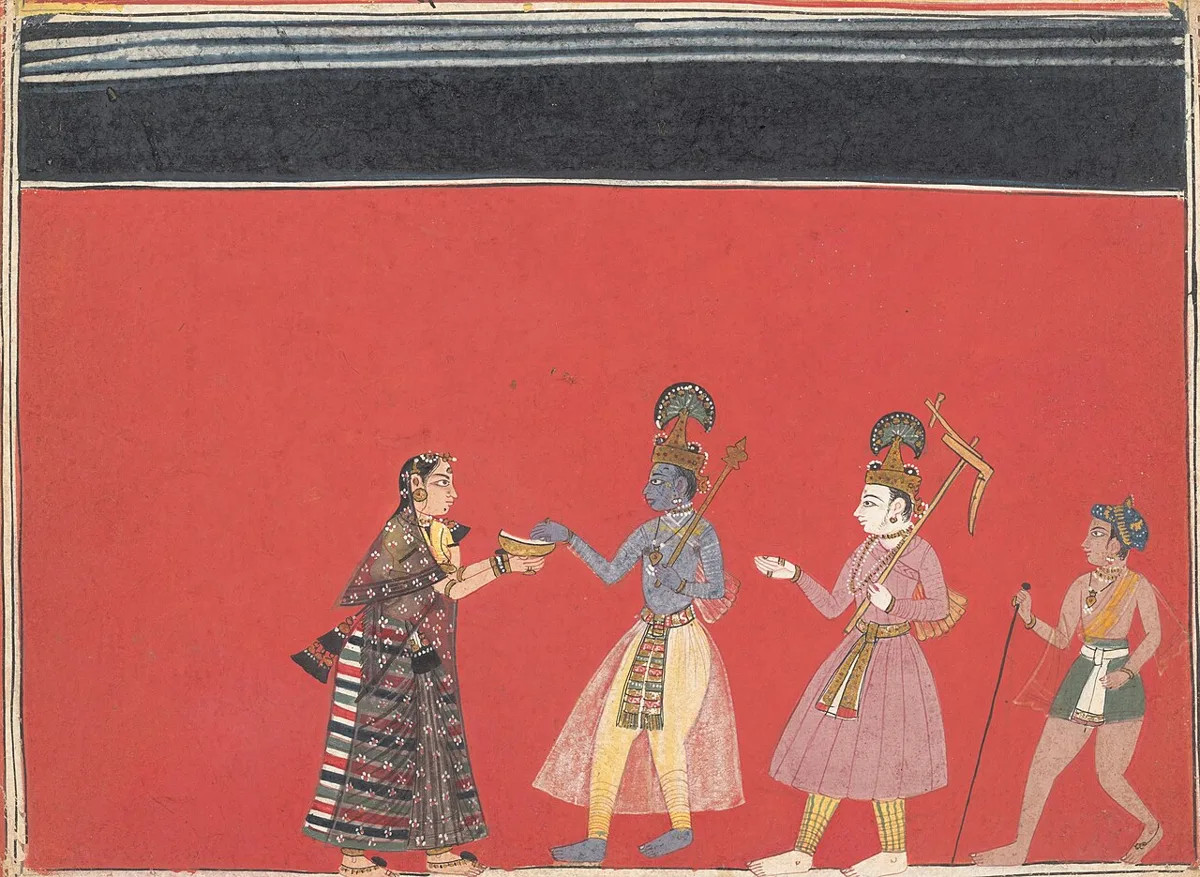
Coming towards them was a young woman with a tray of fragrant ointments. Her face was lovely. But her body was bent, and her name was Trivakra, “bent in three places”. In later tellings she is known as Kubja, the bent one.
Krishna smiled at her. Who are you? he asked. And who are these ointments for? Give us some of your best, and you will be blessed.
She looked up at him. I am a servant of King Kamsa, she said. I make his ointments, and he values them highly. But who deserves them more than the two of you?
She could not take her eyes off Krishna, his face, his smile, the way he spoke. She gave the brothers ointment after ointment, generously, until the two stood there shining with sandal and colour, more handsome than ever.
Straight
Krishna wanted to show her what it means to meet him.
He stepped forward and put his feet on her toes, to hold them down. He placed a finger of each hand under her chin. And gently, he lifted.
Her back straightened. Her shoulders straightened. She stood up tall: a beautiful young woman, straight and whole.
An invitation
She was not shy any more. She caught the end of Krishna’s cloth and smiled. Come home with me, she said. I can’t bear to let you go. Please.
Krishna glanced at Balarama, who was watching, and at their friends from Vraja, and he laughed. When I have finished what I came to Mathura to do, he told her, I will come to your house. She was, he said, a refuge for travellers far from home.
Then, with sweet words, he left her and walked on. Merchants came out of their shops to offer the brothers gifts, and the women of the city stood at their windows, so taken with Krishna that they forgot everything else.
Krishna did not forget her. Later, the Bhagavata Purana tells, when his work in Mathura was done, he went to her house as he had promised. She welcomed him with her friends, adorned herself for him, and the two met as lovers; the Purana tells it openly, and this telling leaves out the detail. She begged him to stay a few days longer, and he promised her that her wish would come true.
The bow
Where is the bow sacrifice? Krishna asked the people of the city. They pointed him to the arena.
There it stood: a huge bow, as grand as the bow of Indra, guarded by soldiers and worshipped as part of the king’s festival. The guards shouted at Krishna to keep back. He did not keep back.
He walked straight up to the bow and picked it up with his left hand. He strung it in an instant. Then he pulled the string, and the great bow snapped in two, the way an elephant snaps a stick of sugarcane.
The crack rang through the earth and the sky. Kamsa heard it, and was struck with terror.
The guards rushed in, shouting, Seize him! Kill him! Krishna and Balarama each picked up half of the broken bow, and the guards did not stand for long.
Krishna had come to Mathura. And Kamsa knew it.
Also named in this story
- Krishna
- Worshipped as God, and as an avatar of Vishnu; in this story a young man arriving in Mathura.
- Kubja
- A young woman of Mathura whose bent body Krishna made straight; the Bhagavata Purana calls her Trivakra.
- Trivakra
- The Bhagavata Purana's name for Kubja.
- Balarama
- Krishna's elder brother.
- Kamsa
- King of Mathura, Krishna's uncle, who sought to kill him.
- Indra
- King of the gods, whose great bow this one was said to rival.
Sources
- Bhagavata Purana, Canto 10, chapter 42 10.42.1–14 · Verified
- Bhagavata Purana, Canto 10, chapter 42 10.42.15–20 · Verified
- Bhagavata Purana, Canto 10, chapter 48 10.48.1–11 · Verified
- Bhagavata Purana, Canto 10, chapter 42 10.42.1–14 · Verified
- Bhagavata Purana, Canto 10, chapter 42 10.42.15–20 · Verified
- Bhagavata Purana, Canto 10, chapter 48 10.48.1–11 · Verified