4-minute story
Dhruva, the pole star
4 min read · as told in the Bhagavata Purana (Book 4, chapters 8, 9 and 12)
The king’s lap
King Uttanapada, son of Svayambhuva Manu, had two queens. Suruchi he loved. Suniti, the mother of his son Dhruva, he neglected.
One day the king sat with Suruchi’s son Uttama on his lap, fondly holding him. Little Dhruva, only five years old, came and tried to climb up beside his brother. The king did not welcome him.
Suruchi was watching, and she spoke in front of the king, so everyone could hear. Dhruva had no right to his father’s lap or his throne, she told him, because he was not born from her womb. If he wanted them so much, let him go and worship Narayana, and be born from her in another life.
Dhruva stood there, breathing hard with anger, like a snake that has been struck with a stick. His father said nothing at all. So Dhruva turned and ran to his mother, trembling and crying.
A mother’s answer
Suniti lifted him onto her lap. When she heard what Suruchi had said, it cut her deeply. But she did not tell her son to fight.
What Suruchi said is true, she told him. The king does not think of me as his wife. Do not wish harm on anyone for it. If you want something higher, worship the Lord. Brahma won his place by worshipping him. So did your grandfather, Svayambhuva Manu. Only the Lord can wipe away a sorrow like yours.
Dhruva listened. He thought it through. Then, with his mind made up, he walked out of his father’s house.
The sage on the road
The sage Narada heard what had happened, and was amazed that a child could be so determined. He came to meet Dhruva.
You are only a boy, Narada said. Go home. When you are grown, you can think about this then.
Dhruva would not go. Your advice is good, he said, but I cannot take it. I was insulted, and I want a place higher than my father’s or my grandfather’s, higher than anyone has ever won. Tell me how to reach it.
Narada saw that nothing would move him. Your mother was right, he said. Go to Madhuvana, the sacred forest on the bank of the Yamuna, and fix your mind on the Lord. And he taught him a twelve-syllable mantra to repeat as he worshipped: “Om namo bhagavate vasudevaya.”
Madhuvana
Dhruva went to Madhuvana and began.
In the first month he ate only fruit and berries, once every three days. In the second month he ate dry grass and leaves, once every six days. In the third month he drank only water, once every nine days. In the fourth month he took a single breath once every twelve days. In the fifth month he stood on one leg, perfectly still, and held the Lord in his mind and nothing else.
The three worlds began to shake. Where Dhruva’s toe pressed the ground, half the earth tilted, like a boat rocked by an elephant climbing aboard. His breath was held so completely that the breath of the whole universe stopped with it. The gods, unable to breathe, ran to the Lord for help.
The Lord comes
The Lord came to Madhuvana on Garuda. All this time Dhruva had been seeing his form within his heart. Suddenly it vanished. Startled, he opened his eyes, and there stood the Lord in front of him.
Dhruva fell to the ground. He wanted to praise him, but he was a child, and he could not find the words. The Lord touched his cheek with his conch, and the prayer poured out of him.
The Lord was pleased. He gave Dhruva something no one had ever been given: the pole star, a place that lasts even when the worlds are dissolved, around which all the stars and planets turn. But first, he said, Dhruva would go home and rule on earth for thirty-six thousand years.
A few broken grains
As the Lord left, Dhruva was not as happy as he had expected. He had found the Lord himself, and what had he asked for? A kingdom. He felt like a poor man who reaches an emperor and asks him for a few broken grains of rice.
Home
His father rode out in a great procession to bring him back, and embraced him. Suruchi blessed him. Suniti held him and would not let go. In time Uttanapada made Dhruva king and went away to the forest.
At the end of his long reign, a celestial chariot came for Dhruva, with Vishnu’s attendants Nanda and Sunanda. When death itself approached, Dhruva placed his feet on death’s head and climbed aboard. But he would not leave without his mother, and they showed him Suniti, going on ahead of him.
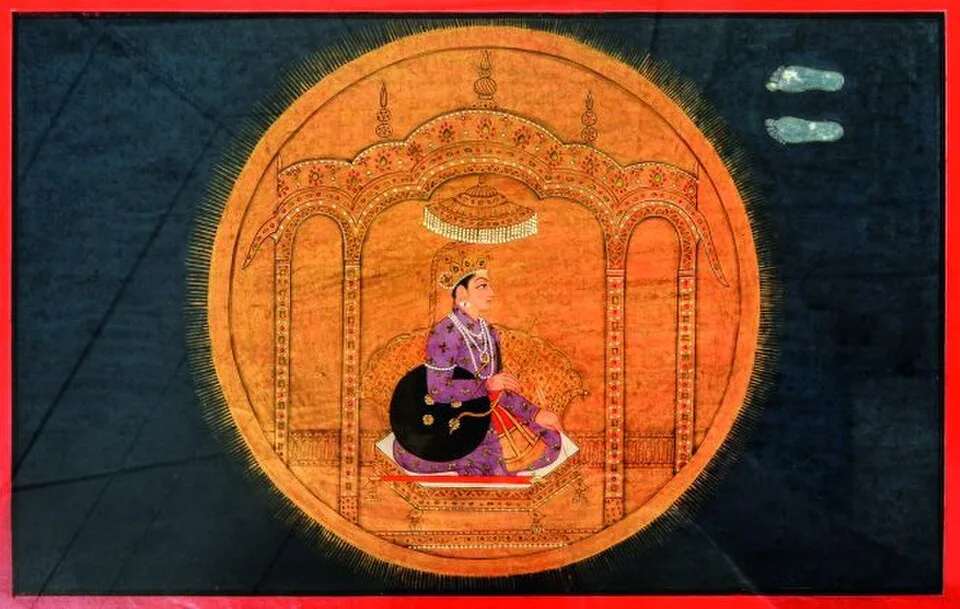
He rose past the worlds of the seven sages, to his own star. And there it stands, the Bhagavata Purana says, with all the lights of the sky turning around it, like oxen tied to a central post. Explore next: Gajendra, the elephant king
Also named in this story
- Dhruva
- A young prince whose devotion to Vishnu won him the pole star.
- Uttanapada
- A king, son of Svayambhuva Manu, and Dhruva's father.
- Suniti
- Dhruva's mother, the king's neglected queen.
- Suruchi
- The king's favourite queen, Dhruva's stepmother.
- Uttama
- Suruchi's son, Dhruva's half-brother.
- Narada
- The wandering sage who taught Dhruva how to worship Vishnu.
- Vishnu
- The god who preserves the world, who appeared to Dhruva.
- Garuda
- The great eagle who carries Vishnu.
- Svayambhuva Manu
- The first Manu, and Dhruva's grandfather.
- Brahma
- The creator god, whom Suniti names as one who won his place by worshipping the Lord.
- Nanda and Sunanda
- Two of Vishnu's attendants, who came to take Dhruva to his star.
- Narayana
- A name of Vishnu.
Sources
- Bhagavata Purana, Canto 4, chapter 8 4.8.7–25 · Verified
- Bhagavata Purana, Canto 4, chapter 8 4.8.26–80 · Verified
- Bhagavata Purana, Canto 4, chapter 9 4.9.1–67 · Verified
- Bhagavata Purana, Canto 4, chapter 12 4.12.23–45 · Verified
- Bhagavata Purana, Canto 4, chapter 8 4.8.7–25 · Verified
- Bhagavata Purana, Canto 4, chapter 8 4.8.26–80 · Verified
- Bhagavata Purana, Canto 4, chapter 9 4.9.1–67 · Verified
- Bhagavata Purana, Canto 4, chapter 12 4.12.23–45 · Verified