3-minute story
Dadhichi gives his bones
3 min read · as told in the Bhagavata Purana (Book 6, chapters 9, 10 and 12)
A father’s revenge
In the days of the gods, Indra, their king, had a priest named Vishvarupa. But Vishvarupa’s mother came from the family of the asuras, and Indra found out that his own priest was secretly making offerings to the asuras too. Afraid that it would make his enemies strong, Indra struck off Vishvarupa’s head.
Vishvarupa’s father was Tvashta, a craftsman of the gods. He did not forgive. He lit a sacrificial fire and poured in his offerings with one wish: raise up an enemy who will kill Indra.
Vritra
From the fire rose a figure that made everyone who saw it run.
He was dark and huge, with copper-coloured hair and piercing eyes, and every day he grew larger, as if he would swallow the sky, the stars and the whole universe. His name was Vritra, because he covered all the worlds.
The gods gathered their armies and attacked him with everything they had: arrows, spears, clubs, every weapon in heaven. Vritra opened his mouth and swallowed them all.
The gods pray
The gods stood there with empty hands. Their strength was gone. Together they turned to the only one left to turn to, and prayed to Vishnu.
Vishnu appeared before them, holding his conch, his disc and his club, and they fell at his feet.
There is a way, Vishnu told them. Go to the sage Dadhichi, and ask him for his body. From his bones, Vishvakarma, the architect of the gods, will make a thunderbolt. With that thunderbolt, and my power within it, Indra will kill Vritra.
What the gods asked
So the gods went to Dadhichi’s hermitage, and stood before the old sage, and asked him for his body.
Dadhichi smiled. Do you know, he said, how hard it is to die? Every living thing clings to its body. No one would give it up, not even if Vishnu himself came and asked for it.
The gods did not give up. A great soul, they said, does not refuse those who come to him in need.
Dadhichi laughed. I only wanted to hear what you would say, he told them. Of course I will give it.
The gift
This body will leave me one day anyway, Dadhichi said. Why not let it be used for something good? A person who feels nothing when others suffer, and nothing when they are happy, is pitied even by the trees and the stones. A body is worth something only when it is used for others.
Then he sat down, quieted his senses and his breath, his mind and his thoughts, and placed his soul at the feet of the Lord. And without even feeling it, he left his body behind.
The thunderbolt
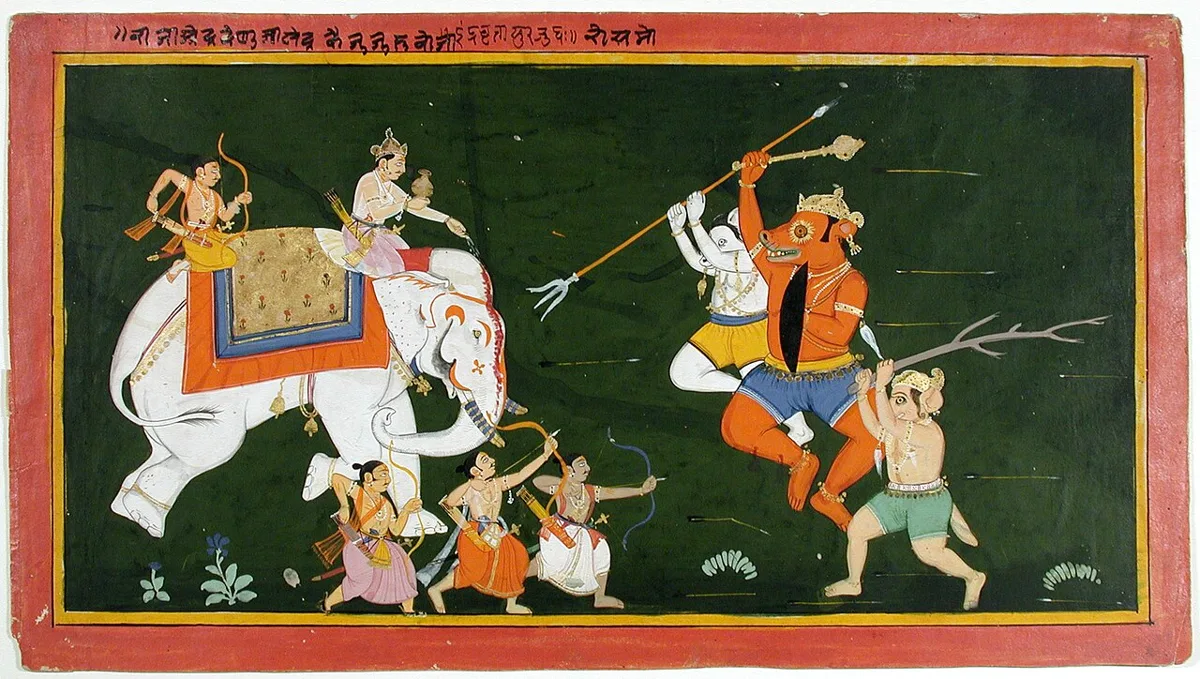
From Dadhichi’s bones was made the vajra, the thunderbolt. Indra took it in his hand and climbed onto Airavata, his white elephant. With the gods behind him and the sages singing his praises, he rode out to find Vritra, on the bank of the river Narmada.
Swallowed
The battle was terrible. Vritra cut and Indra struck; at one point the thunderbolt flew from Indra’s hand. Pick it up, he told Indra. Victory and defeat are in the Lord’s hands, not ours. Fight on.
Then Vritra grew enormous, opened his mouth, and swallowed Indra and his elephant whole.
The gods cried out. But inside the giant, Indra was alive. Protected by his armour and the Lord’s power, he took the thunderbolt made from Dadhichi’s bones, and cut his way out through Vritra’s belly. Then he struck off his head.
The gods and the heavenly singers rejoiced. It was the old sage’s gift that had saved them.
Also named in this story
- Dadhichi
- A great sage, also called Dadhyancha, who gave his bones to the gods.
- Vritra
- A giant asura, born from Tvashta's sacrifice to destroy Indra.
- Indra
- King of the gods, who carries the thunderbolt.
- Tvashta
- A craftsman of the gods, Vishvarupa's father.
- Vishvarupa
- Tvashta's son, a priest of the gods.
- Vishnu
- The god who preserves the world, to whom the gods prayed.
- Vishvakarma
- The divine architect, who made the thunderbolt.
- Airavata
- Indra's white elephant.
- Narmada
- A sacred river of central India.
Sources
- Bhagavata Purana, Canto 6, chapter 9 6.9.1–54 · Verified
- Bhagavata Purana, Canto 6, chapter 10 6.10.2–16 · Verified
- Bhagavata Purana, Canto 6, chapter 12 6.12.1–35 · Verified
- Bhagavata Purana, Canto 6, chapter 9 6.9.1–54 · Verified
- Bhagavata Purana, Canto 6, chapter 10 6.10.2–16 · Verified
- Bhagavata Purana, Canto 6, chapter 12 6.12.1–35 · Verified